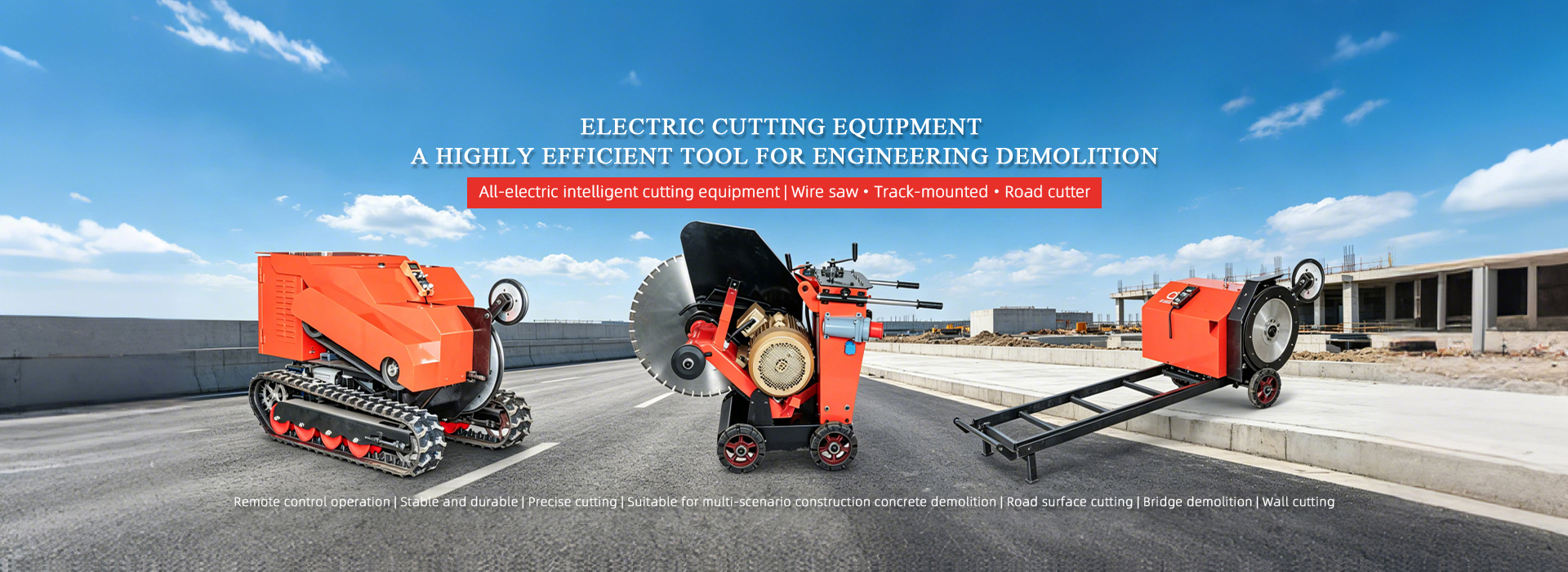
The crawler-type wire saw machine is a specialized device integrating a crawler traveling mechanism and a wire saw cutting system. Its core advantage lies in autonomous movement across complex terrains (e.g., mountainous areas, muddy ground) to perform cutting operations on large concrete components or stone materials. During cutting, the device produces minimal vibration, and the flatness tolerance of the cutting surface can be controlled within±2mm, reducing subsequent finishing workload.
Core Components:
・Crawler Travel Chassis: Features a wide crawler design with low ground contact pressure, equipped with a battery-powered travel system. It enables flexible climbing and steering, adapting to unimproved ground in mines, wilderness, and other environments.
・Wire Saw Cutting Unit: Includes an electric motor power source (22-37KW), drive wheels, guide wheels, and a diamond bead wire. With strong power, it enables linear cutting of large-section materials.
・Control & Adjustment System: Equipped with a wireless remote control system for safe breaking and cutting operations. It supports variable-frequency speed regulation of the main motor, provides a soft-start function for complex working conditions (e.g., large areas, multiple chamfer machining), and some models feature an automatic tension control system for automated cutting.
Key Features:
・Exceptional Terrain Adaptability: The crawler design allows easy traversal of muddy ground, slopes (maximum climbing angle up to 30°), and gravel areas without additional towing equipment, making it suitable for off-grid outdoor scenarios.
Application Scenarios:
・Mine Stone Quarrying: Replaces traditional blasting in granite and marble mines, enabling damage-free cutting and separation of blocks to improve stone utilization rates.
・Large-Scale Project Demolition: Performs static cutting demolition of concrete structures (e.g., bridge piers, reservoir embankments, large equipment foundations) to avoid vibration impacts on surrounding buildings.
・Outdoor Special Operations: Includes rock cutting, highway bridge renovation, tunnel portal contour trimming, and breaking of large obstacles in post-disaster (earthquake, collapse) sites.






 客服1
客服1 客服3
客服3
